Welcome to the official website of Nanjing Tamso Optoelectronics Co., Ltd.

The principle of light emission of LED gas station lights is based on the electroluminescence of semiconductor materials. When an electric current passes through the semiconductor, it excites electrons, which then release energy in the form of light as they return to their original state. Compared to traditional metal halide lamps, LED lights have several advantages: 1. **Energy Efficiency**: LEDs consume significantly less power than metal halide lamps, leading to lower energy costs. 2. **Longer Lifespan**: LEDs typically last much longer, often exceeding 50,000 hours, while metal halide lamps may only last around 15,000 hours. 3. **Instant Lighting**: LEDs provide instant illumination without the warm-up time required by metal halide lamps. 4. **Lower Heat Emission**: LEDs emit less heat, reducing the risk of overheating and improving safety. 5. **Environmental Impact**: LEDs are more environmentally friendly as they do not contain harmful substances like mercury, which is found in metal halide lamps.
Aug 24,2020
Keywords: LED Gas Station Light
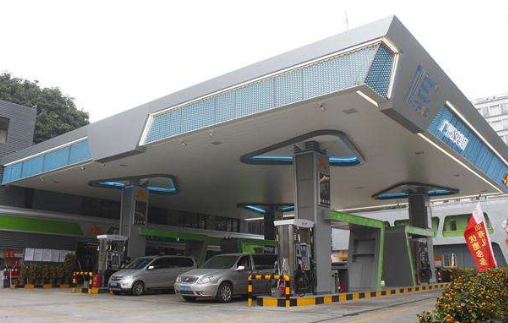
If everyone pays a little more attention when refueling at gas stations, they will notice that the lights at gas stations are different from the street lights nearby, because they use LED explosion-proof lights, which are specially designed for the unique nature of gas stations. So, do you know how the LED gas station light works? Additionally, did you know that gas stations initially used metal halide lamps? What advantages do LED lights have compared to traditional metal halide lamps? The advantages include better safety, less heat generation, and lower indoor temperature. They are also more energy-efficient and have a longer lifespan. The average lifespan of a regular metal halide lamp is about 10,000 hours, while the lifespan of LED light source chips is around 50,000 hours. Below is a detailed analysis introduction; interested friends can take a look at the detailed introduction.
Working Principle of LED Gas Station Light:
LED is a solid-state semiconductor device that can directly convert electricity into light. The heart of the LED is a semiconductor chip, one end of which is attached to a bracket, with one end being the negative electrode and the other connected to the positive electrode of the power supply, encapsulating the entire chip in epoxy resin.
The semiconductor chip consists of two parts: one part is P-type semiconductor, where holes dominate, and the other end is N-type semiconductor, where electrons are predominant. When these two types of semiconductors are connected, they form a "P-N junction" between them.
When current flows through the wire to this chip, electrons are pushed towards the P region, where they recombine with holes, emitting energy in the form of photons, directly converting electrical energy into light. There is low light loss, high luminous efficiency, long lifespan, and no radiation.

Advantages of LED Gas Station Light Compared to Traditional Metal Halide Lamps:
What advantages do LED lights have compared to traditional metal halide lamps? Better safety, more energy-efficient, and longer lifespan; below is a detailed analysis introduction.
1. LED lights have better safety: Compared to metal halide light sources, LED light sources generate less heat, making them safer and less likely to produce large amounts of heat or increase indoor temperature.
LED lights output a safe voltage of 35V DC, with low current, making them less likely to produce electrical sparks, thus safer than metal halide lamps.
2. LED lights are more energy-efficient: Although the price of LED lights is higher than that of metal halide lamps, when calculated over the long term, the savings on electricity bills can generally recover the price difference in about three years.
3. LED lights have a longer lifespan: The average lifespan of a regular metal halide lamp is about 10,000 hours, and after 10,000-15,000 hours, both the light source and electrical components need to be replaced, with the costs of the light source and electrical components accounting for about 60% of the lamp's cost.
The lifespan of LED light source chips is around 50,000 hours, and the lifespan of electrical components is about 25,000 hours. Maintenance generally only requires replacing electrical components, which costs only a few dozen yuan. Because of the longer lifespan, maintenance frequency and costs are reduced.

The above is the introduction to the working principle of LED gas station lights and their advantages compared to traditional metal halide lamps. If you have any questions, feel free to contact our editor.
Previous:

Contact Us

Telephone:13186631992 025-83569917
Fax: 025-84199977
E-mail:njtansuo@163.com
Address: No.10 Kaicheng Road, Qilin Gate, Jiangning District, Nanjing City, Jiangsu Province, China

sweep Focus on us