Welcome to the official website of Nanjing Tamso Optoelectronics Co., Ltd.

What are the expression techniques of urban landscape lighting projects and the commonly used light sources for lighting fixtures?
May 20,2020
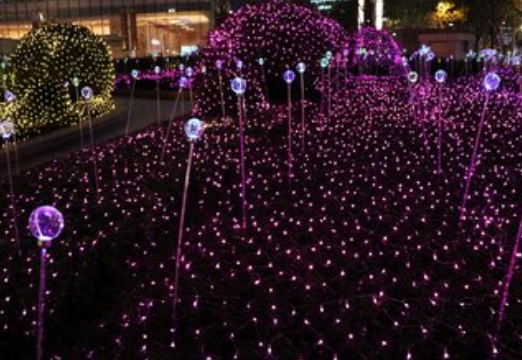
Lighting projects are decorative lighting used in places with high foot traffic, such as urban blocks, commercial areas, buildings, and attractions. It has advantages such as a wide field of vision, diverse shapes, and a strong sense of three-dimensionality. When designing lighting for buildings, it is essential to understand the characteristics of the building and its architectural style to identify the most eye-catching features from different angles, which will determine the methods of expression. Below, I will briefly introduce this.
What are the methods of expression in urban landscape lighting projects?
The expression of lighting projects can be achieved by using different lighting fixtures, colors, and brightness. It is important to choose compatible fixtures based on the characteristics of different buildings, allowing the building and the lighting project to blend perfectly. Common methods include using light strips to outline the building's contours, highlighting the shape of the roof, and using floodlights and line lights to create a bright surface on the building's facade.
Using light strips to outline the contours of buildings and landscapes can weave a colorful three-dimensional shape at night. To make the effect more vivid and lively, the light strips can be controlled to alternate between light and dark, scan, or chase.
Additionally, buildings with different functions should be represented with different colors. For example, using appropriately colored light strips to outline the contours of the building and the edges of each floor can highlight the building's layers and its nighttime position. Moreover, the roof can be outlined with floodlights or light strips to create a golden roof or roofs of other colors. Landmark buildings can also have laser lights or rose lights installed on top.
Landscape lighting projects are a perfect blend of art and light, decorating our cities while enriching people's nightlife. With the continuous advancement of technology, the technical content of lighting projects is also increasing, and the methods and forms of expression in lighting projects will become more diverse, creating more beautiful night scenes for cities.
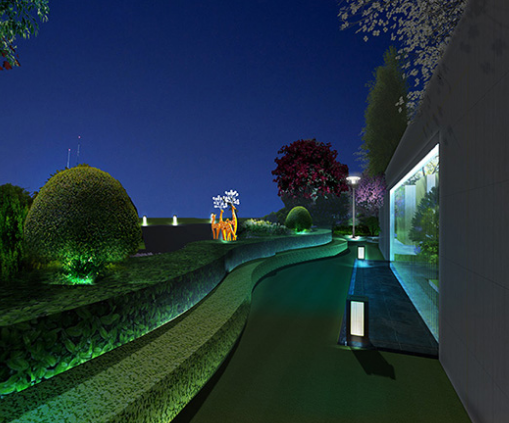
Common light sources used in urban landscape lighting projects.
A building, a garden, a scenic area, or even a city—no matter how perfect the landscape design is, if it encounters poor lighting at night, half of its life is ruined. In addition to focusing on the aesthetics of lighting, the safety of landscape lighting cannot be ignored. Since most landscape lighting is set outdoors, some types of fixtures (such as underground lights, mud-inserted lights, etc.) may come into close contact with human activities, making safety during their application particularly important: not only do insects have phototropism, but children do too. Therefore, when facing many nighttime landscape lighting situations, parents are especially concerned about the light hazards and electric shock risks of the fixtures.
The impact of the lighting environment on vision is mainly reflected in brightness and color. People have different psychological feelings towards different colors; for example, red and orange give a warm feeling, while warm colors express a pleasant, warm, and luxurious atmosphere. Blue gives a cold feeling, while cool light colors express tranquility, elegance, and freshness. This requires that in lighting engineering design, light sources be reasonably selected based on landscape effects to improve lighting effects, ensuring that the brightness and color of the illuminated objects differ from yet harmonize with the surrounding environment. Common light sources used by outdoor lighting companies for landscape lighting include the following types:
Incandescent lamps have low light efficiency, about 10 to 14 lm/W, and their average lifespan is generally only 1000 hours. However, they are easy to use, inexpensive, and have good color rendering (with an average color rendering index above 95). Typically, bulbs with a power greater than 40W need to be filled with a certain pressure of argon or nitrogen to prevent the filament from vaporizing. At this time, the color of the light will be partially absorbed by the argon or nitrogen, and the shorter wavelengths may not be represented, making the colors red, green, and yellow more pronounced, resulting in a yellowish light source. Outdoor lighting companies commonly use them for contour lighting, light strings, underwater lighting, etc.
Gas discharge lamps: including metal halide lamps, sodium lamps, and compact fluorescent lamps. Due to the continuous improvement of their color rendering index and high light efficiency, these types of light sources are widely used by outdoor lighting companies.

The above is my introduction, and I hope it helps everyone understand the methods of expression and common light sources in landscape lighting. For more related knowledge, please pay attention to our news updates.

Contact Us

Telephone:13186631992 025-83569917
Fax: 025-84199977
E-mail:njtansuo@163.com
Address: No.10 Kaicheng Road, Qilin Gate, Jiangning District, Nanjing City, Jiangsu Province, China

sweep Focus on us